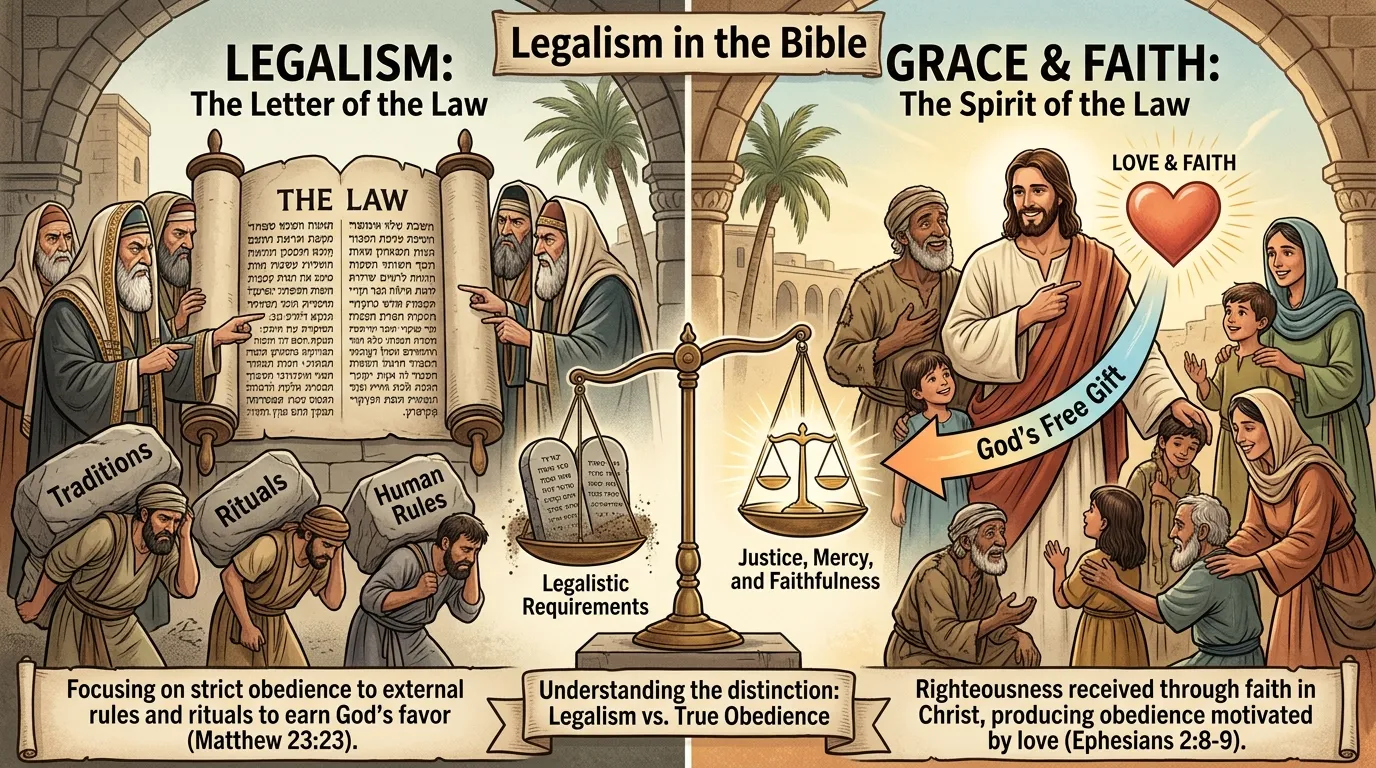
Are you following rules to earn God’s love or living in the freedom He already gave you? The Legalism Meaning in Bible is one of the most misunderstood yet critically important topics in Christian faith. Legalism occurs when people rely on strict rule-following and religious performance to gain salvation or God’s approval rather than trusting in His grace and mercy.
The Bible strongly warns against this dangerous mindset throughout both the Old and New Testaments. The Apostle Paul directly confronted legalism in Galatians reminding believers that salvation comes through faith alone not human effort or religious rituals.
Understanding the Legalism Meaning in Bible helps Christians break free from guilt religious bondage and spiritual exhaustion. It restores the joy of genuine faith and deepens your relationship with God. If you’ve ever felt trapped by religious rules this truth will set you completely and beautifully free.
What Does Legalism Mean in the Bible?
Legalism in the Bible refers to the belief that a person can earn righteousness, salvation, or God’s approval through strict rule-keeping rather than through faith, grace, and relationship with God.
In simple terms:
- Legalism = “I must earn God’s acceptance”
- Biblical grace = “I am already loved, then I respond in obedience”
The word “legalism” itself is not directly found in Scripture, but the concept is strongly addressed throughout both the Old and New Testaments.
Is the Word “Legalism” in the Bible?
The exact word legalism does not appear in the original biblical texts.
However, its meaning is rooted in:
- Greek New Testament discussions of the Law (Nomos)
- The Pharisaic interpretation of the Law in Jesus’ time
- Paul’s teachings about grace vs. works
Biblical Foundation
- Greek: Nomos = Law
- Hebrew: Torah = Instruction/Law
The Bible often contrasts:
- External rule-keeping
- Internal transformation through faith
The Spiritual Core of Legalism in Scripture
1. When Rules Replace Relationship
Jesus directly addressed legalism in His teachings.
Key Verse
“These people honor me with their lips, but their heart is far from me.” Matthew 15:8
Meaning
Legalism happens when:
- Actions look religious
- But the heart is disconnected
It creates spiritual performance without inner transformation.
2. When Religion Becomes Burden Instead of Freedom
Key Verse
“Come to me, all who are weary and burdened, and I will give you rest.” Matthew 11:28
Meaning
Jesus contrasts:
- Heavy religious burden
- Spiritual rest and peace
Legalism often produces:
- Guilt
- Fear
- Constant self-judgment
- Emotional exhaustion
Grace produces:
- Peace
- Confidence
- Restoration
3. When External Appearance Replaces Inner Change
Key Verse
“You clean the outside of the cup, but inside you are full of greed and self-indulgence.” Matthew 23:25
Meaning
Legalism focuses on:
- Outward behavior
- Religious image
But ignores:
- Heart healing
- Emotional transformation
This creates spiritual imbalance and identity confusion.
4. When Law Is Used Without Grace
Key Verse
“For the letter kills, but the Spirit gives life.” 2 Corinthians 3:6
Meaning
The law alone cannot transform the human heart.
Without grace:
- Faith becomes rigid
- Worship becomes mechanical
- God feels distant
With grace:
- Faith becomes alive
- Worship becomes relational
- God feels close
5. Freedom in Christ vs Religious Pressure
Key Verse
“It is for freedom that Christ has set us free.” Galatians 5:1
Meaning
True spirituality is not bondage to rules but freedom in love.
Legalism says:
- “Do more to be accepted”
Grace says:
- “You are accepted, now grow”
Modern-Day Relevance of Legalism
Legalism is not just a biblical concept it still appears in modern life in subtle ways.
1. Anxiety and Spiritual Pressure
Many people feel:
- “I am never doing enough spiritually”
- “I keep failing God”
This creates chronic spiritual anxiety.
2. Identity Confusion
Legalism can cause:
- Self-worth based on performance
- Fear of failure in faith
- Emotional disconnection from God
3. Relationship Struggles
In relationships, legalism appears as:
- Judging others harshly
- Lack of emotional grace
- Difficulty forgiving mistakes
4. Personal Growth Blockage
Instead of growth, legalism creates:
- Perfectionism
- Fear of mistakes
- Lack of emotional freedom
Dreams, Repeated Signs, and Spiritual Interpretation
Some people associate legalism struggles with spiritual dreams or repeated inner thoughts.
Spiritual Perspective
Biblically, dreams sometimes reflected:
- Conviction
- Direction
- Inner correction
- Emotional awakening
Psychological Perspective
From psychology, dreams may represent:
- Inner conflict between guilt and grace
- Pressure vs freedom
- Identity struggle
Synchronicity Experience
People may repeatedly notice themes like:
- “Grace”
- “Rest”
- “Freedom”
This often reflects internal processing of emotional and spiritual tension.
Scientific Insight: Psychology Behind Legalism Thinking
Legalistic thinking often connects to the subconscious mind.
1. Subconscious Conditioning
People raised in strict environments may develop:
- Performance-based identity
- Fear of failure
- Approval-seeking behavior
2. Identity Formation
The brain builds identity through:
- Repeated messages
- Emotional experiences
- Authority influence
If a person repeatedly hears “you must earn approval,” it shapes belief patterns.
3. Emotional Symbolism
Religious pressure can symbolize:
- Fear of rejection
- Need for acceptance
- Inner perfectionism
Understanding this helps separate:
- Healthy spirituality
- Emotional conditioning
Practical Life Lessons: Moving Beyond Legalism
1. Practice Grace-Based Reflection
Ask daily:
- Am I living in fear or freedom?
- Am I performing or relating?
2. Build Gratitude Instead of Guilt
Focus on:
- What is already given
- What is already forgiven
- What is already enough
3. Honest Prayer Practice
Prayer does not require perfection. It requires honesty.
Simple prayer:
- “Help me understand grace”
- “Teach me freedom in You”
4. Emotional Awareness
Notice feelings like:
- Guilt without reason
- Fear of not being enough
- Constant self-criticism
These may signal legalistic thinking patterns.
5. Replace Performance With Relationship
Shift focus from:
- “What must I do?”
To: - “Who am I becoming in love and grace?”
Balanced Spiritual Perspective
It is important to stay balanced.
Not all discipline is legalistic.
Healthy biblical living includes:
- Moral responsibility
- Spiritual growth
- Personal accountability
But the difference is motivation:
- Legalism = fear-based obedience
- Grace = love-based transformation
Not every spiritual struggle is a sign of failure. Sometimes it is part of emotional and spiritual growth.
FAQs:
What is legalism in simple words?
Legalism is believing you must earn God’s acceptance through rules and actions instead of receiving it through grace.
Is legalism mentioned in the Bible?
The exact word is not used, but the concept is strongly addressed by Jesus and Paul.
What is the opposite of legalism?
The opposite of legalism is a grace relationship with God based on faith, not performance.
Can legalism affect mental health?
Yes. It can contribute to anxiety, guilt, perfectionism, and emotional pressure.
How do I overcome legalism?
By shifting from rule-based faith to relationship-based faith through grace, reflection and emotional awareness.
Conclusion:
Understanding legalism meaning the Bible is not just about theology it is about emotional healing and identity restoration.
Legalism often creates:
- Fear instead of faith
- Pressure instead of peace
- Performance instead of purpose
But biblical grace invites something deeper:
- Rest instead of exhaustion
- Identity instead of insecurity
- Relationship instead of religion
At the heart of Scripture is not a demand for perfection, but an invitation to transformation through love.
You are not meant to live under constant spiritual pressure. You are meant to live in freedom, growth, and restored identity.
And sometimes, the most powerful spiritual shift begins not with doing more but with finally believing you are already accepted, and then learning to live from that truth.