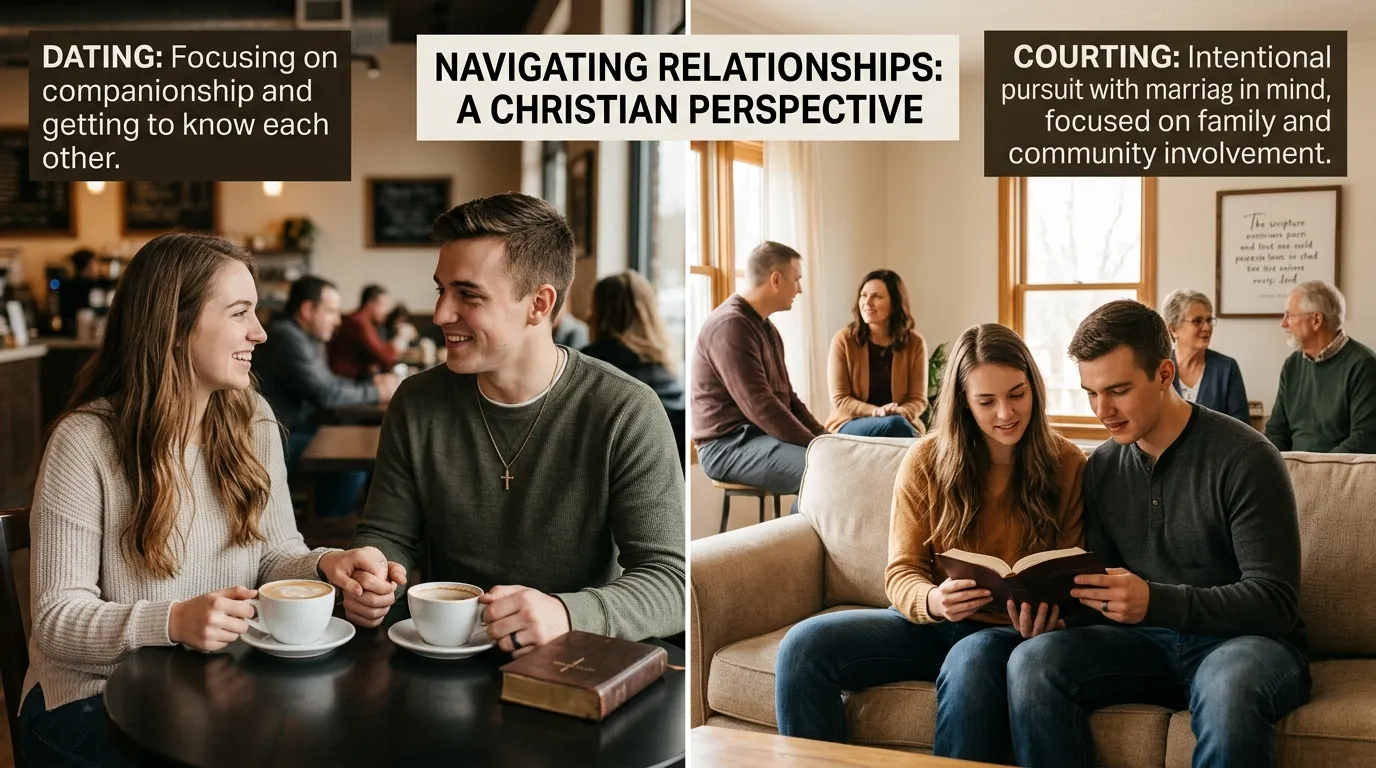
In today’s modern world, many believers find themselves asking a very important question what is the difference between courting vs dating Christian style? While the culture promotes casual dating with little commitment the Bible calls Christians to a higher standard in relationships.
Courting vs dating Christian values are vastly different courting is intentional, God-centered, and focused on marriage, while casual dating often prioritizes feelings over faith. For Christian singles seeking a godly relationship, understanding the distinction between courting vs dating Christian principles can be life-changing.
Courting involves family involvement, accountability and spiritual alignment, whereas modern dating can lead to emotional and physical compromise. God designed relationships to reflect His love, commitment, and purpose. If you are single, searching or simply curious, exploring the courting vs dating Christian perspective will equip you to build a relationship that truly honors God and leads to a blessed, lasting marriage.
What Does “Courting vs Dating Christian” Mean in a Biblical Context?
In Christian understanding, courting vs dating refers to two different approaches to romantic relationships: dating often focuses on emotional exploration and compatibility, while courting emphasizes intentional commitment with marriage as the clear goal. The Bible does not directly use the modern terms “courting” or “dating,” but it provides principles for love, purity, wisdom, and intentional relationships.
Does the Bible Mention Courting or Dating?
The exact terms “courting” and “dating” do not appear in the Bible. These are modern cultural concepts.
However, the Bible strongly addresses relationship principles in Hebrew and Greek contexts:
Hebrew and Greek Foundations of Relationships
- Hebrew emphasis: “Yadah” (ידע) meaning to know deeply, intimately, and experientially
- Greek emphasis: “Agape” (ἀγάπη) meaning selfless, sacrificial love
- Greek: “Phileo” (φιλία) meaning friendship-based affection
These words show that biblical relationships were built on:
- deep knowing
- covenant commitment
- emotional and spiritual responsibility
Biblical Principles Behind Courting vs Dating Christian Relationships
1. Intentionality Over Emotion
“The plans of the diligent lead surely to abundance…” – Proverbs 21:5
Modern dating often begins with attraction. Biblical relationships begin with intention and wisdom.
Key Insight:
Emotions are real but not always reliable. Scripture encourages believers to seek direction before deep emotional attachment.
2. Purity and Self-Control
“For this is the will of God, your sanctification…” – 1 Thessalonians 4:3-5
One of the strongest biblical principles in relationships is emotional and physical purity.
Courting typically emphasizes:
- boundaries
- accountability
- community involvement
Dating culture often struggles with:
- blurred boundaries
- emotional dependency
- physical temptation
3. Wisdom Before Attachment
“Above all else, guard your heart…” – Proverbs 4:23
Psychologically, early emotional attachment can cloud judgment.
Biblical wisdom teaches:
- observe character before emotion
- evaluate consistency over chemistry
- prioritize long-term fruit over short-term feeling
4. Purpose-Driven Relationships
“Two are better than one…” – Ecclesiastes 4:9
Relationships are not just emotional experiences, they are purpose partnerships.
Courting aligns more with:
- marriage intention
- spiritual alignment
- shared values
Dating often focuses on:
- exploration
- compatibility testing
- emotional experience
5. Community and Accountability
“Plans fail for lack of counsel…” – Proverbs 15:22
Biblical relationships were never meant to exist in isolation.
Healthy Christian relationship patterns include:
- mentorship
- family awareness
- spiritual accountability
Courting vs Dating Christian: Key Differences Explained
Courting (Intentional Commitment Path)
- Marriage-focused from the beginning
- Strong boundaries
- Family and community involvement
- Purpose-driven emotional connection
- Slower emotional development
Dating (Exploratory Relationship Path)
- Focus on emotional connection and compatibility
- Flexible commitment levels
- Individual-centered decision making
- More emotional experimentation
- Unclear long-term direction in some cases
Psychological Insight: Why Modern Relationships Feel Confusing
Modern relationship confusion is often not spiritual failure, it is psychological overload.
Emotional Causes:
- Fear of loneliness
- Attachment insecurity
- Social media comparison
- Emotional impulsivity
Identity Confusion in Relationships
Many people enter relationships without clear identity:
- “Who am I without someone else?”
- “Do I need love to feel complete?”
- “Am I choosing this person or my loneliness?”
Biblical wisdom responds by grounding identity first before relationships.
Modern-Day Relevance: Anxiety, Identity, and Relationship Pressure
Today, young adults face intense emotional pressure in relationships:
Anxiety in Dating Culture
- Fear of rejection
- Fear of wasting time
- Fear of choosing wrong partner
Identity Confusion
Without spiritual grounding, relationships become identity sources instead of expressions of identity.
Personal Growth Challenges
Unhealthy patterns include:
- emotional dependency
- rushing intimacy
- ignoring red flags
- confusing chemistry with compatibility
Courting principles often help slow down emotional intensity and promote clarity.
Dreams, Repeated Signs, and Relationship Synchronicity
Many people interpret emotional experiences in relationships as spiritual signs:
- dreaming about a person repeatedly
- feeling “destined” connection
- seeing repeated reminders of someone
Spiritual Interpretation
Some believers see this as:
- emotional confirmation
- spiritual prompting
- reflection of prayerful desire
Psychological Interpretation
Psychology explains this as:
- subconscious focus
- emotional attachment bias
- pattern recognition
- longing projection
Balanced Truth
Not every emotional intensity is a divine confirmation, but it can still reflect:
- inner desires
- unresolved emotions
- psychological attachment
Discernment is essential.
Scientific Insight: How the Brain Forms Relationship Attachment
Subconscious Influence
The brain stores emotional experiences and links them with identity.
Attachment Theory
People often develop patterns:
- anxious attachment (fear of abandonment)
- avoidant attachment (fear of closeness)
- secure attachment (balanced connection)
Emotional Symbolism
People often assign meaning to:
- texts
- timing
- coincidences
- repeated thoughts
This is how emotional meaning is formed not always externally, but internally processed.
Practical Life Lessons for Healthy Christian Relationships
1. Build Identity Before Relationship
Ask:
- Who am I for God’s purpose?
- What are my values?
- What do I stand for emotionally?
2. Practice Emotional Awareness
Notice:
- attraction vs attachment
- peace vs pressure
- clarity vs confusion
3. Strengthen Boundaries
Healthy boundaries include:
- emotional limits
- physical discipline
- communication clarity
4. Cultivate Gratitude and Patience
Rushed love often creates confusion. Gratitude builds emotional stability.
5. Develop Prayer-Based Decision Making
Prayer is not emotional escape, it is clarity training.
Balanced Perspective: Courting vs Dating Is Not Legalism
It is important to understand:
- The Bible does not command a single relationship model
- Courting is a principle-based approach, not a law
- Dating can also be healthy when guided by wisdom
The real difference is not the label, it is the intention, discipline, and spiritual maturity behind it.
Featured Snippet Summary
Courting vs dating Christian difference: Courting focuses on intentional, marriage-oriented relationships with strong boundaries and spiritual accountability, while dating is more exploratory and focused on emotional compatibility. The Bible does not explicitly mention either term but provides principles of love, wisdom, purity, and intentional relationships.
FAQs:
Is courting biblical or dating?
The Bible does not mention either term directly but supports principles like intentionality, purity, and wisdom in relationships.
Is courting better than dating?
Neither is universally “better.” Courting is more structured and marriage-focused, while dating is more exploratory.
Can Christians date or should they only court?
Christians can date or court, but the key is applying biblical principles like purity, wisdom, and intentionality.
What is the main purpose of Christian relationships?
The primary purpose is to reflect love, build godly character and move toward covenant commitment in alignment with faith.
Conclusion:
Understanding courting vs dating Christian values is essential for every believer seeking a godly relationship. Courting places God at the center, prioritizing purpose, purity and lasting commitment over temporary emotions.
While the world promotes casual dating, Scripture calls Christians to pursue relationships with intention and integrity. Choosing the courting vs dating Christian path is not always easy, but it is always worth it. Trust God’s design, follow his word and he will lead you to the relationship he has perfectly planned for you.

James Harper is a passionate writer and digital creator known for sharing insightful, engaging, and easy-to-understand content. With a strong interest in technology, creativity, and modern trends, he aims to inspire readers through informative articles and fresh ideas. His writing style combines simplicity with professionalism, making content enjoyable for every audience.