Have you ever stopped to wonder why rocks in the Bible appear in some of the most powerful and life-changing moments in all of Scripture? From Moses striking a rock to release water in the desert to the stone rolled away from Jesus’ empty tomb, rocks are never just background details they are divine symbols carrying deep spiritual meaning.
Rocks in the Bible represent the strength, stability and unshakeable faithfulness of God in a world that is constantly changing. God Himself is called a Rock a refuge a fortress and a deliverer for all who trust in Him. If used as altars of worship, memorials of miracles or symbols of salvation, rocks in the Bible carry messages that are just as relevant and powerful today as they were thousands of years ago. Get ready to see Scripture in a brand new light.
What Do Rocks Represent in the Bible?
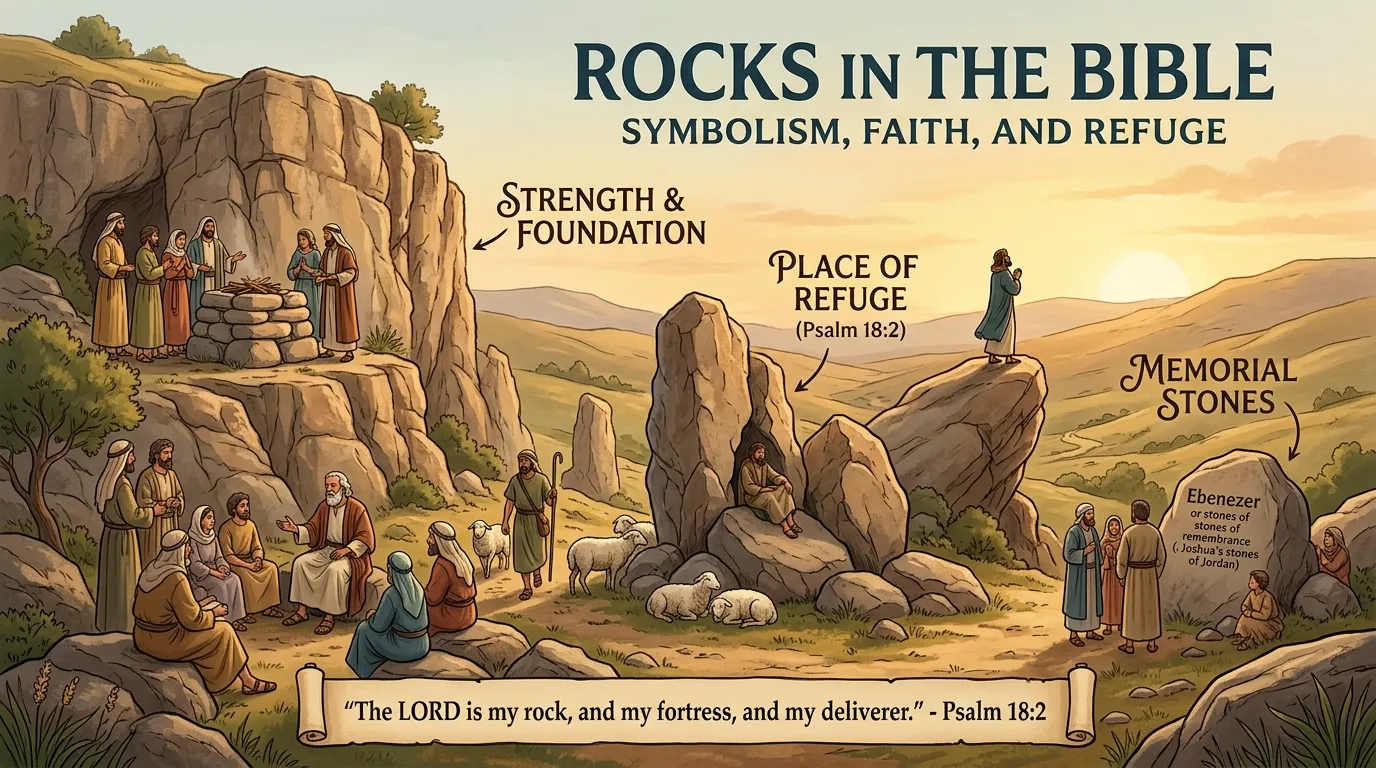
In the Bible, rocks symbolize stability, God’s strength, spiritual foundation, protection, and divine truth. They are used to describe God Himself, faith, and the believer’s spiritual grounding in difficult times.
Do Rocks Appear in the Bible?
Yes, rocks appear throughout the Bible in both literal and symbolic ways. The word “rock” comes from Hebrew and Greek roots:
Hebrew Meaning
- “Tzur” (צוּר) → rock, fortress, strength, refuge
- Often used to describe God as a stable foundation
Greek Meaning
- “Petra” (πέτρα) → large rock, bedrock, foundation
- Used in the New Testament to symbolize strong spiritual grounding
Rocks are not just natural elements in Scripture they represent divine stability in a chaotic world.
Spiritual Meaning of Rocks in the Bible
1. God as the Ultimate Rock of Stability
In biblical teaching, God is often described as a rock.
Key Verse
“The Lord is my rock, my fortress and my deliverer.” Psalm 18:2
Spiritual Insight
A rock does not move easily. In the same way, God represents:
- Emotional stability during chaos
- Protection during fear
- Strength during weakness
When people feel mentally overwhelmed or spiritually lost, this symbol becomes deeply grounding.
2. Rocks as a Symbol of Faith Foundation
Key Verse
“On this rock I will build my church…” Matthew 16:18
Meaning Explained
Here, “rock” represents a strong spiritual foundation.
Simple Understanding
- Faith is not meant to be fragile
- Life built on truth remains stable
- Identity rooted in God does not collapse easily
Modern Insight
In psychology, strong belief systems create:
- Emotional resilience
- Mental stability
- Identity clarity
3. Rocks as Protection and Refuge
Key Verse
“He set my feet on a rock and gave me a firm place to stand.” Psalm 40:2
Spiritual Meaning
Rocks symbolize a safe place in unstable seasons.
Life Application
People often experience “rock moments” when:
- Life feels uncertain
- Relationships break down
- Anxiety increases
The symbolism reminds believers that stability is still possible even in emotional storms.
4. Rocks as Judgment and Consequences
Not all biblical references to rocks are comforting.
Key Verse
“The stone the builders rejected has become the cornerstone.” Psalm 118:22
Meaning
Rocks also represent:
- Truth that cannot be ignored
- Consequences of decisions
- Spiritual accountability
Deep Insight
Truth can feel hard like a stone, but it remains unchanging. This reflects how life often forces growth through difficult reality checks.
5. Rocks as Spiritual Transformation
Key Verse
“I will give you a heart of stone and replace it with a heart of flesh.” Ezekiel 36:26
Meaning Explained
God transforms emotional hardness into softness.
Psychological Connection
This mirrors real human healing:
- Trauma can “harden” emotions
- Healing restores empathy and openness
- Growth requires inner transformation
Rocks represent both resistance and transformation.
Modern-Day Relevance of Rocks in the Bible
In today’s world, people face:
- Anxiety about the future
- Identity confusion
- Emotional burnout
- Relationship instability
- Constant pressure from society
What the “Rock” Symbol Means Today
A rock represents:
- Emotional grounding during stress
- Stability in uncertain careers
- Strength in broken relationships
- Identity that is not based on social validation
Example
A person going through a breakup may feel emotionally unstable. The biblical “rock” symbol reminds them that stability is still possible internally, even when external life feels broken.
Dreams, Signs, and Synchronicity: Seeing Rocks Spiritually
Many people report dreams involving rocks, stones, or mountains.
Possible Spiritual Interpretation
- Need for stability
- Reminder of faith foundation
- Emotional protection
- Life transition phase
Psychological Interpretation
From a psychological view:
- Rocks symbolize subconscious desire for security
- The mind uses “solid objects” to represent stability
- Emotional stress increases symbolic dreaming
Key Insight
Not every dream is a divine message, but dreams often reflect:
- Inner fears
- Emotional processing
- Life direction concerns
Scientific Insights: Why Rocks Symbolism Feels Powerful
1. Subconscious Mind Connection
The brain uses symbols like rocks to represent:
- Safety
- Strength
- Permanence
2. Identity Formation
Humans build identity using stable reference points. Rocks symbolize:
- Consistency
- Reliability
- Grounded self-image
3. Emotional Symbolism
Under stress, the brain seeks “anchors.” Rocks naturally represent:
- Emotional grounding
- Psychological safety
Practical Life Lessons from Rocks in the Bible
1. Build Emotional Stability
Create habits that ground you:
- Daily reflection
- Journaling thoughts
- Quiet time for self-awareness
2. Practice Gratitude
Gratitude helps stabilize emotional instability by shifting focus from fear to awareness of support.
3. Strengthen Inner Faith
Faith is not only religious it is also psychological confidence in stability during uncertainty.
4. Develop Emotional Awareness
Ask yourself:
- What is shaking my emotional stability?
- What gives me peace?
- What do I rely on when life feels unstable?
5. Stay Spiritually and Mentally Balanced
Not every symbolic experience is a divine message. Some are emotional reflections. Wisdom comes from balance, not extremes.
Balanced Perspective: What Rocks Truly Teach Us
Rocks in the Bible do not mean:
- Every situation is fixed
- Every hardship is punishment
- Every sign is supernatural
Instead, they teach:
- Stability is possible
- Truth remains constant
- Inner strength can be built
- Emotional grounding is essential
FAQs:
What do rocks symbolize in the Bible?
Rocks symbolize strength, stability, protection, faith foundation, and God’s unchanging nature.
Why is God called a rock in the Bible?
Because a rock represents something strong, unmovable, and dependable during life’s storms.
What does a rock in dreams mean spiritually?
It may symbolize stability, emotional grounding, or a need for inner strength.
Is seeing rocks a spiritual sign?
It can be symbolic, but not every occurrence is a divine sign. It often reflects emotional or subconscious processing.
What is the Hebrew meaning of rock in the Bible?
The Hebrew word “Tzur” means fortress, strength, and refuge.
Conclusion:
The deeper you explore rocks in the Bible, the more you realize that God leaves nothing to chance. Every rock, every stone and every altar in Scripture carries a divine fingerprint a message of strength, salvation, provision and eternal faithfulness.
From the rock that poured water in the wilderness to the cornerstone that the builders rejected, God used ordinary stones to reveal extraordinary truths about his nature and His love for humanity. These powerful symbols are not just ancient stories they are living lessons for every believer walking through life today.
As you open your Bible, look closely at every rock along the way, because God is still speaking through them. Rocks in the Bible will anchor your faith to the One who never moves, never fails and never changes.