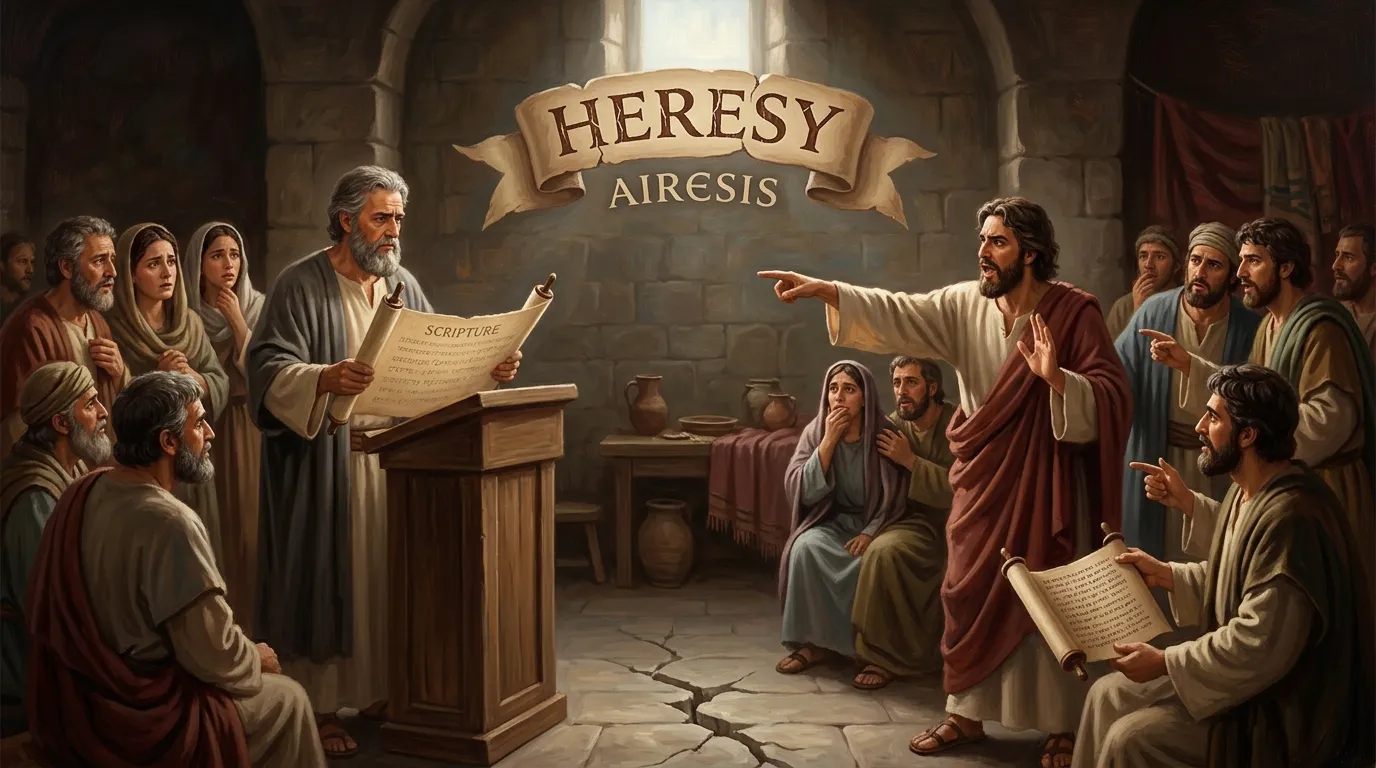
Have you ever sat in a church service or scrolled through a Christian social media feed and felt something was slightly off like the message sounded spiritual but did not quite line up with what the Bible actually teaches? That uncomfortable but important feeling is exactly what understanding the heresy meaning in the Bible equips every believer to recognize, name, and stand firmly against with grace and biblical confidence.
The word heresy comes from the Greek word hairesis meaning a chosen opinion, a sect, or a divisive faction that departs from established and sound biblical truth. In the early church heresy was not just a theological disagreement it was a dangerous deviation from the core truths of the Gospel that had the power to shipwreck faith and divide entire communities of believers.
The Apostle Peter warned every generation of Christians about this very danger in 2 Peter 2:1 declaring, “There will be false teachers among you who will secretly introduce destructive heresies even denying the sovereign Lord who bought them.” This powerful warning captures the entire heresy meaning in the Bible in one sobering truth false teaching is never loud and obvious at first.
It always enters quietly, subtly, and with just enough spiritual language to make it sound completely believable. Understanding the heresy meaning in the Bible is not about becoming suspicious or critical of everyone around you it is about loving God’s truth so deeply and knowing his Word so thoroughly that every counterfeit teaching becomes immediately recognizable to your spiritually trained and biblically anchored heart.
What Does Heresy Mean in the Bible?
In the Bible, heresy refers to false teaching, divisive beliefs, or opinions that depart from God’s truth and lead people away from sound biblical doctrine. The Greek word translated as “heresy” originally meant a choice, party, or sect, but in the New Testament it often describes teachings that create division or oppose the Gospel of Jesus Christ.
Simply put, the heresy meaning in the Bible includes:
- False teaching.
- Doctrinal error.
- Divisive beliefs.
- Departing from biblical truth.
- Leading people away from Christ.
Does the Word “Heresy” Appear in the Bible?
Yes.
The word heresy appears several times in the King James Version (KJV) of the New Testament.
Modern Bible translations may use words such as:
- False teaching.
- Divisions.
- Sects.
- Factions.
- False doctrines.
Although the wording varies, the central message remains the same: believers are called to remain faithful to God’s truth and avoid teachings that distort the Gospel.
Greek Origin of the Word “Heresy”
To fully understand the heresy meaning in the Bible, it’s helpful to look at the original Greek language.
Hairesis (αἵρεσις)
The Greek word translated as heresy is Hairesis.
It originally meant:
- Choice.
- School of thought.
- Party.
- Sect.
- Division.
Over time, especially in the New Testament, the word came to describe groups or teachings that departed from apostolic truth and created harmful divisions within the church.
Rather than simply referring to a different opinion, it came to describe teachings that endangered genuine faith.
Why Is Heresy an Important Biblical Theme?
From the earliest days of the church, believers encountered teachers who distorted the Gospel.
Some denied the identity of Jesus.
Others added human traditions to God’s truth.
Still others promoted teachings motivated by pride, personal influence, or financial gain.
The apostles consistently warned Christians to remain rooted in Scripture and carefully examine every teaching they encountered.
Understanding the heresy meaning in the Bible helps answer important questions such as:
- How can Christians recognize false teaching?
- Why does sound doctrine matter?
- What happens when truth is compromised?
- How can believers remain spiritually grounded?
The Bible consistently teaches that truth protects faith and strengthens the church.
The Biblical Meaning of Heresy: Powerful Spiritual Lessons
1. Truth Protects Believers From Spiritual Deception
The first lesson connected with the heresy meaning in the Bible is that God’s truth protects His people.
False teaching often sounds convincing because it mixes truth with error.
That is why believers are encouraged to know Scripture well enough to recognize teachings that do not align with God’s Word.
Spiritual discernment grows through a close relationship with God and consistent study of the Bible.
Bible Verse
“Beloved, believe not every spirit, but try the spirits whether they are of God.” 1 John 4:1 (KJV)
Simple Explanation
John encourages believers to carefully examine every teaching instead of accepting every spiritual claim without question.
God wants his people to seek truth with wisdom and discernment.
Modern Example
Someone may encounter online videos, books, or social media posts that quote Bible verses but remove them from their proper context.
Comparing every teaching with Scripture helps believers recognize truth from error.
Life Application
Ask yourself:
“Am I building my beliefs on God’s Word or simply following popular opinions?”
A strong foundation in Scripture protects against spiritual confusion.
2. Heresy Often Creates Division Instead of Unity
Another important lesson connected with the heresy meaning in the Bible is that false teaching frequently leads to unnecessary conflict and division.
While healthy discussions can strengthen understanding, teachings that distort the Gospel often divide believers and shift attention away from Christ.
God calls His people to remain united in truth, humility, and love.
Biblical unity is built on sound doctrine not compromise with error.
Bible Verse
“There must also be heresies among you, that which are approved may be made manifest.” 1 Corinthians 11:19 (KJV)
Simple Explanation
Paul explains that false teachings sometimes reveal who remains faithful to God’s truth.
Challenges can strengthen genuine believers by encouraging them to remain grounded in Scripture.
Modern Example
A church may face confusion because of teachings that focus more on personalities or human traditions than on Christ.
Returning to biblical truth helps restore unity and spiritual health.
Life Application
Ask yourself:
“Do my beliefs encourage unity around Christ and his Word, or unnecessary division?”
True biblical teaching always points people toward Jesus rather than personal agendas.
3. Spiritual Discernment Must Be Developed, Not Assumed
Another important lesson connected with the heresy meaning in the Bible is that spiritual discernment grows through intentional learning and a close relationship with God.
Simply hearing a message that sounds inspiring does not guarantee it is biblically accurate. The Bible encourages believers to study God’s Word personally so they can recognize truth from error.
Discernment is developed through prayer, Scripture, humility, and the guidance of the Holy Spirit.
Bible Verse
“Study to shew thyself approved unto God… rightly dividing the word of truth.” 2 Timothy 2:15 (KJV)
Simple Explanation
Paul encourages believers to handle God’s Word carefully and accurately.
Knowing Scripture helps Christians avoid misunderstanding, false teaching, and spiritual confusion.
Modern Example
Someone may hear conflicting opinions about Christianity through podcasts, social media, or online influencers.
Instead of accepting every claim, they compare each teaching with the Bible and seek wisdom from mature Christian leaders.
Life Application
Ask yourself:
“Am I growing in my understanding of Scripture, or am I depending only on what others tell me?”
A believer who studies God’s Word develops confidence and discernment.
4. False Teaching Often Begins With Small Compromises
The heresy meaning in the Bible reminds us that major doctrinal errors rarely appear all at once.
Many false teachings begin with subtle distortions of biblical truth. A small compromise, when left unchallenged, can gradually lead people further away from the Gospel.
That is why the apostles repeatedly urged believers to remain watchful and faithful.
Protecting truth begins by taking God’s Word seriously.
Bible Verse
“A little leaven leaveneth the whole lump.” Galatians 5:9 (KJV)
Simple Explanation
Paul uses yeast as an illustration.
Just as a small amount of yeast spreads throughout dough, a small amount of false teaching can eventually influence an entire group if it is left unchecked.
Modern Example
A teacher may begin by minimizing the authority of Scripture or changing one central biblical truth.
Over time, those small changes can reshape an entire belief system.
This is why biblical discernment is so important.
Life Application
Ask yourself:
“Do I examine new ideas carefully through the lens of Scripture?”
Remaining faithful in small matters helps protect our faith over time.
5. Sound Doctrine Produces Spiritual Growth
The goal of biblical teaching is not simply gaining knowledge.
God’s truth is meant to transform lives.
The heresy meaning in the Bible reminds believers that healthy doctrine produces healthy spiritual fruit, including love, humility, wisdom, compassion, and obedience.
When people truly understand God’s Word, it shapes both their beliefs and their daily lives.
Bible Verse
“All scripture is given by inspiration of God… that the man of God may be perfect, thoroughly furnished unto all good works.” 2 Timothy 3:16–17 (KJV)
Simple Explanation
The Bible equips believers for faithful living.
God’s Word teaches, corrects, encourages, and prepares Christians to serve Him wisely.
Modern Example
A believer who studies Scripture consistently often becomes more patient, gracious, forgiving, and spiritually mature.
True biblical teaching changes character, not just knowledge.
Life Application
Ask yourself:
“Is my study of God’s Word making me more like Christ?”
Growing in truth should always lead to growing in love and obedience.
Bible Verses About Heresy Explained Simply
The Bible contains several passages that help explain the heresy meaning in the Bible and why believers should guard sound doctrine.
1 John 4:1 Test Every Spirit
“Believe not every spirit, but try the spirits whether they are of God.”
Simple Meaning
Christians should carefully examine teachings rather than accepting every spiritual claim without testing it against Scripture.
2 Timothy 2:15 Handle God’s Word Correctly
“Rightly dividing the word of truth.”
Simple Meaning
Believers are encouraged to study Scripture carefully so they can understand and apply God’s truth accurately.
Galatians 5:9 Small Errors Can Spread
“A little leaven leaveneth the whole lump.”
Simple Meaning
Even small doctrinal errors can eventually influence many people if they are not corrected.
2 Peter 2:1 False Teachers
“There shall be false teachers among you.”
Simple Meaning
Peter warns that false teachers will arise and encourages believers to remain faithful to the truth of the Gospel.
2 Timothy 3:16–17 Scripture Equips Believers
“All scripture is given by inspiration of God.”
Simple Meaning
The Bible provides everything believers need for spiritual growth, wisdom, correction, and faithful living.
Why the Heresy Meaning in the Bible Still Matters Today
Although the word heresy may sound ancient, its message is extremely relevant in today’s world.
When You’re Surrounded by Conflicting Opinions
The internet provides endless voices, opinions, and interpretations.
The Bible encourages believers to evaluate every teaching carefully instead of accepting ideas simply because they are popular or persuasive.
Truth should always be measured by Scripture.
When You’re Searching for Your Identity
Many voices today attempt to define personal identity through culture, achievement, or public opinion.
The heresy meaning in the Bible reminds believers that lasting identity is found in Christ and His truth, not in changing human philosophies.
When Relationships Are Influenced by Beliefs
Healthy relationships grow stronger when they are built on honesty, humility, love, and biblical wisdom.
False teaching often creates unnecessary confusion and division, while God’s truth encourages unity grounded in Christ.
When You’re Pursuing Personal Growth
Personal development is valuable, but lasting transformation comes from God’s truth working within the heart.
Biblical wisdom shapes character, strengthens integrity, and encourages lifelong spiritual maturity.
When You Need Discernment
Every believer faces decisions about what to believe, whom to trust, and how to live.
Developing biblical discernment helps Christians navigate confusing messages while remaining faithful to Jesus Christ.
Dreams, Repeated Signs, and Synchronicity: What Could Heresy Mean Spiritually?
Many people begin searching for the heresy meaning in the Bible after reading the New Testament, hearing a sermon about false teachers, or encountering conflicting interpretations of Scripture.
Others become curious after dreaming about being lost, hearing confusing messages, choosing between different paths, or trying to distinguish truth from deception.
These experiences often lead to questions like:
- Why do I keep seeing the word “heresy” in the Bible?
- Does dreaming about false teaching have a biblical meaning?
- Could repeated Bible verses about heresy be a message from God?
- How can I know whether I’m following the truth?
These are thoughtful questions, and the Bible encourages believers to seek answers with wisdom and discernment.
Scripture shows that God uses His Word to teach, correct, and strengthen His people. Sometimes a particular biblical topic stands out because it addresses an area where we need to grow. At the same time, the Bible also teaches that not every dream, repeated word, or coincidence is automatically a direct message from God.
God’s written Word remains the ultimate standard for truth.
The Spiritual Meaning of Repeatedly Seeing the Word “Heresy”
If the word heresy keeps appearing during Bible study, sermons, devotionals, or conversations, it may simply encourage you to become more grounded in God’s truth.
Consider asking yourself:
- Am I studying Scripture regularly?
- Do I test what I hear against God’s Word?
- Am I growing in spiritual discernment?
- Do my beliefs draw me closer to Christ?
- Am I open to correction when Scripture challenges my thinking?
These questions encourage maturity rather than fear.
God desires believers who seek truth with humility and wisdom.
Dreaming About Heresy: A Biblical Perspective
Dreams involving confusion, misleading directions, counterfeit messages, divided groups, or searching for truth can feel spiritually significant.
The Bible records occasions when God communicated through dreams, but it does not teach that every dream carries prophetic meaning.
Many dreams simply reflect emotions, personal experiences, concerns, and the information our minds process each day.
If you dream about themes related to heresy, it may encourage reflection on areas such as:
- Spiritual discernment
- Biblical truth
- Wisdom
- Personal convictions
- Faithfulness
- Humility
- Growing in God’s Word
Rather than asking,
“Is this dream predicting my future?”
consider asking,
“What biblical truth can I apply because of this experience?”
That approach keeps your attention centered on Scripture instead of speculation.
Understanding Synchronicity from a Christian Perspective
Some people describe meaningful coincidences as synchronicity.
Perhaps you read about false teachers in 2 Peter, hear a sermon about sound doctrine, and later encounter a Bible study on discernment.
Experiences like these may seem connected.
From a biblical perspective, they should always be evaluated carefully.
Helpful questions include:
- Does this agree with Scripture?
- Does it strengthen my faith in Christ?
- Does it encourage wisdom and humility?
- Does it produce peace instead of fear?
- Does it help me know God’s Word more deeply?
If repeated encounters with this topic motivate you to study Scripture more faithfully and seek God’s truth, they have already served a valuable purpose.
The goal is always spiritual growth not chasing hidden meanings.
The Psychological Perspective: Why Certain Biblical Themes Stay in Your Mind
Psychology also helps explain why specific biblical ideas remain on our minds during certain seasons of life.
These insights complement biblical wisdom rather than replacing it.
The Role of the Subconscious Mind
Your subconscious mind naturally processes ideas that feel important or emotionally meaningful.
If you’ve recently been thinking about truth, deception, decision-making, or spiritual growth, your brain becomes more aware of related themes.
You may begin noticing concepts such as:
- Wisdom
- Truth
- Discernment
- Faith
- Integrity
- Understanding
This increased awareness is a normal part of how human attention works.
Identity Formation and Personal Beliefs
Psychologists recognize that our beliefs shape many of our choices and behaviors.
The heresy meaning in the Bible encourages believers to build their identity on God’s truth rather than shifting cultural opinions or personal preferences.
When beliefs are grounded in Scripture, people often experience greater confidence, stability, and purpose.
A strong foundation helps believers navigate uncertainty with wisdom.
Emotional Symbolism in Dreams
Dreams often communicate emotions through symbolic images.
For example:
- Walking down the wrong road may symbolize uncertainty or confusion.
- Reading a confusing book may reflect difficulty processing new ideas.
- Finding a trustworthy guide may symbolize wisdom and spiritual growth.
- Light breaking through darkness may represent clarity and truth.
- Returning to the correct path may symbolize repentance and renewed direction.
These symbols should not automatically be interpreted as supernatural messages.
In many cases, they simply reflect emotional or spiritual themes your mind is processing.
When viewed alongside Scripture, they can encourage meaningful self-reflection.
Scientific Insights: Why Certain Spiritual Themes Keep Appearing
Modern psychology and neuroscience also provide insight into why topics like truth, belief, and discernment continue capturing our attention.
Although science cannot determine spiritual truth, it helps explain how people learn, remember, and evaluate information.
Selective Attention
When a topic becomes personally meaningful, your brain naturally notices related information more frequently.
Someone studying the heresy meaning in the Bible may suddenly notice verses about discernment, wisdom, and truth throughout Scripture because their attention has become focused on those themes.
Critical Thinking and Decision-Making
Research shows that healthy decision-making improves when people evaluate information carefully rather than reacting emotionally.
This aligns with the Bible’s repeated encouragement to test teachings, seek wisdom, and think carefully before accepting new ideas.
Biblical discernment combines faith with thoughtful examination.
Lifelong Learning
Studies consistently show that people who remain curious, teachable, and willing to learn often make wiser long-term decisions.
The Bible encourages the same attitude by calling believers to continue growing in knowledge, wisdom, and understanding throughout life.
Spiritual maturity is an ongoing journey.
Practical Life Lessons from the Heresy Meaning in the Bible
Understanding the heresy meaning in the Bible becomes most valuable when it influences everyday life.
Here are practical habits that help believers remain grounded in God’s truth.
Read the Bible Consistently
Regular Scripture reading builds a strong foundation for recognizing truth and avoiding deception.
The more familiar you become with God’s Word, the easier it is to identify teachings that do not align with it.
Pray for Wisdom
Ask God to give you discernment when making decisions or evaluating spiritual teachings.
James 1:5 reminds believers that God generously gives wisdom to those who ask.
Practice Humility
Be willing to learn, ask questions, and accept correction when Scripture challenges your thinking.
Humility keeps the heart teachable.
Develop Emotional Awareness
Strong emotions can sometimes influence judgment.
Learning to recognize fear, pride, anger, or excitement helps believers make wiser, more balanced decisions.
Stay Connected to Mature Believers
Healthy Christian community provides encouragement, accountability, and wise guidance.
Studying God’s Word together strengthens both faith and discernment.
A Balanced and Trustworthy Perspective
As we’ve explored the heresy meaning in the Bible, one important truth deserves special attention.
Not every disagreement among Christians is heresy.
Throughout church history, sincere believers have held different views on many secondary issues while remaining united in the core truths of the Christian faith.
Likewise, not every dream, repeated Bible verse, or coincidence should automatically be interpreted as a supernatural sign from God.
The Bible consistently encourages believers to:
- Study Scripture carefully.
- Pray for wisdom.
- Test every teaching.
- Seek counsel from mature Christians.
- Remain humble and teachable.
- Keep Jesus Christ and the Gospel at the center of their faith.
Truth and love should always work together.
FAQs
What does heresy mean in the Bible?
The heresy meaning in the Bible refers to false teaching, divisive beliefs, or doctrines that depart from God’s revealed truth and lead people away from the Gospel of Jesus Christ.
Is every false belief considered heresy?
Not necessarily. In the biblical sense, heresy usually refers to serious doctrinal error that contradicts essential Christian truth and creates harmful division within the church.
How can Christians recognize heresy?
Believers can recognize heresy by comparing every teaching with Scripture, praying for discernment, and learning from faithful, biblically grounded Christian leaders.
Why did the apostles warn so strongly about heresy?
False teaching can mislead believers, weaken faith, create division, and distort the message of the Gospel. The apostles wanted Christians to remain firmly grounded in God’s truth.
How can I protect myself from false teaching?
Study the Bible regularly, pray for wisdom, stay connected to a healthy church, ask thoughtful questions, and evaluate every teaching according to Scripture rather than popularity.
Final Thoughts:
The heresy meaning in the Bible is one of the most important and practically relevant warnings found anywhere in Scripture for believers living in today’s world of endless information, social media theology, and celebrity Christianity. God never called His people to be gullible he called them to be grounded.
Acts 17:11 celebrates the Berean believers who received the Word with great eagerness and examined the Scriptures every day to see if what they were being taught was true. That is God’s timeless standard for every believer in every generation receive teaching with an open heart but always test it against the unchanging truth of God’s Word.
False teaching has never been more accessible or more dangerous than it is today. So here is your powerful challenge commit to knowing God’s Word so deeply and so personally that no heresy however subtle or spiritually packaged could ever lead you away from the truth that the heresy meaning in the Bible calls you to guard with your whole heart and life.