Some words in the Bible are easy to understand at first glance. Others seem unfamiliar, almost intimidating, yet they carry some of the most powerful truths in all of Scripture. Propitiation is one of those words.
Perhaps you came across it while reading the New Testament, listening to a sermon, or studying a Bible verse about Jesus’ sacrifice. At first, it may have sounded like an old theological term with little connection to everyday life. But the more you looked into it, the more questions surfaced.
What does propitiation mean in the Bible? Why was Jesus called the propitiation for our sins? Is this word only about God’s wrath, or does it also reveal His love, mercy, and forgiveness?
These are important questions because understanding the propitiation meaning in the Bible helps us understand the very heart of the Gospel. It reveals how God’s perfect justice and incredible mercy come together through Jesus Christ. More than a complex theological concept, propitiation is a message of hope for anyone seeking forgiveness, peace with God, and confidence in His love.
At the same time, it’s important to approach this subject with humility and careful study. Biblical words deserve to be understood within their proper context rather than through assumptions or isolated verses. As we explore this topic together, we’ll look at what Scripture actually teaches, explain difficult ideas in simple language, and connect these timeless truths to everyday life.
In this guide, you’ll discover the propitiation meaning in the Bible, whether the word appears in Scripture, its original Greek and Hebrew background, why it matters for Christians today, and the first powerful spiritual lessons that reveal God’s character and His plan for humanity.
What Does Propitiation Mean in the Bible?
The propitiation meaning in the Bible refers to the sacrifice that satisfies God’s righteous justice against sin and restores the relationship between God and humanity. Christians believe that Jesus Christ became the perfect propitiation through His death on the cross, making forgiveness and reconciliation with God possible for everyone who places their faith in Him.
In simple terms, biblical propitiation teaches that:
- God is perfectly holy and just.
- Sin separates humanity from God.
- Jesus willingly took the penalty for sin.
- God’s justice and mercy meet through Christ’s sacrifice.
- Believers can receive forgiveness and peace with God through faith.
Does the Word “Propitiation” Appear in the Bible?
Yes. The word propitiation appears several times in many English Bible translations, particularly the King James Version (KJV), New King James Version (NKJV), and some formal translations like the English Standard Version (ESV).
Two of the best-known passages include:
- Romans 3:25
- 1 John 2:2
- 1 John 4:10
Some modern Bible translations use expressions such as:
- Atoning sacrifice
- Sacrifice of atonement
- Means of forgiveness
- Sacrifice that removes sin
Although the wording differs, the biblical message remains the same. These translations all point to Jesus Christ as the One who made reconciliation with God possible through His sacrificial death.
Hebrew and Greek Meaning of Propitiation
To fully understand the propitiation meaning in the Bible, it’s helpful to explore the original biblical languages. Doing so reveals that this word is about much more than simply avoiding punishment. It speaks of forgiveness, reconciliation, mercy, and God’s desire to restore His relationship with humanity.
Hebrew Background of Propitiation
Although the English word propitiation appears mainly in the New Testament, its foundation begins in the Old Testament.
One important Hebrew word connected to this idea is:
Kaphar (כָּפַר)
The Hebrew word Kaphar means:
- To cover
- To make atonement
- To reconcile
- To cleanse from sin
This word is closely associated with the sacrificial system established under the Old Covenant.
On the Day of Atonement, sacrifices were offered to symbolically cover the sins of the people. These sacrifices pointed forward to the ultimate sacrifice that Christians believe would later be fulfilled through Jesus Christ.
The idea was never simply about ritual.
It was about restoring a broken relationship between a holy God and sinful humanity.
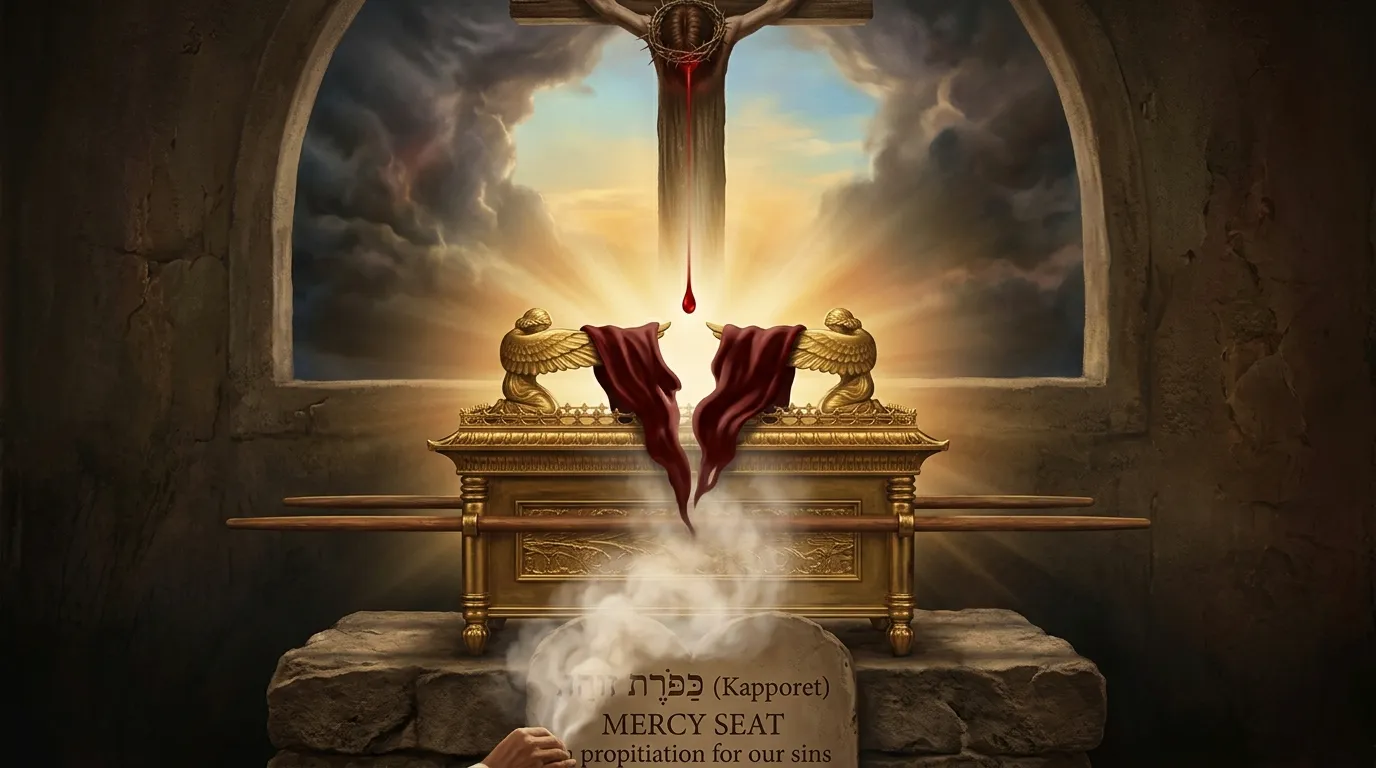
Kapporet (כַּפֹּרֶת)
Another important Hebrew word is Kapporeth, commonly translated as the Mercy Seat.
The Mercy Seat was the golden cover placed on top of the Ark of the Covenant inside the Most Holy Place.
According to the Old Testament, it represented the place where God’s presence met with His people and where atonement for sin was symbolically made.
This imagery becomes deeply significant when the New Testament later describes Jesus as the perfect fulfillment of God’s plan for redemption.
Greek Meaning of Propitiation
The New Testament uses several Greek words that deepen our understanding of propitiation.
Hilastērion (ἱλαστήριον)
One of the most important Greek words is Hilastērion, which can mean:
- Propitiation
- Mercy Seat
- Atoning sacrifice
- Place of reconciliation
In Romans 3:25, Paul uses this word to describe Jesus as the One through whom God provides forgiveness and reconciliation.
This connection intentionally points back to the Old Testament Mercy Seat, showing that Jesus fulfills what the ancient sacrificial system anticipated.
Hilasmos (ἱλασμός)
Another key Greek word is Hilasmos, meaning:
- Atoning sacrifice
- Propitiation
- Means of forgiveness
This word appears in 1 John 2:2 and 1 John 4:10, emphasizing that Jesus willingly became the sacrifice for humanity’s sins because of God’s great love.
Together, these Greek terms reveal that propitiation is not about an angry God reluctantly choosing to forgive.
Instead, it reveals a loving God who Himself provides the way for justice and mercy to meet.
Why Is Propitiation Such an Important Biblical Theme?
Many people think Christianity is mainly about trying to become a better person.
While spiritual growth certainly matters, the Bible teaches that the heart of the Gospel is something much deeper.
It is about reconciliation.
From the opening chapters of Genesis onward, Scripture tells the story of humanity’s broken relationship with God because of sin.
Throughout the Old Testament, sacrifices pointed toward God’s promise to provide a lasting solution.
The New Testament declares that Jesus fulfilled that promise.
Understanding propitiation helps answer questions such as:
- Why did Jesus have to die?
- Why couldn’t God simply ignore sin?
- How can a holy God forgive imperfect people?
- What makes Christianity different from every other religion?
The biblical answer is found in propitiation.
Through Christ’s sacrifice, God’s justice is satisfied while His mercy is freely extended to everyone who believes.
This truth lies at the very center of Christian faith.
The Biblical Meaning of Propitiation: Powerful Spiritual Lessons
1. Propitiation Reveals Both God’s Justice and His Love
One of the greatest misunderstandings about propitiation is the idea that it only focuses on God’s judgment.
In reality, propitiation reveals two equally important truths:
- God is perfectly holy and just.
- God is perfectly loving and merciful.
Neither truth cancels out the other.
Instead, they work together beautifully.
Because God is holy, sin cannot simply be ignored.
Because God is loving, He provided the solution Himself through Jesus Christ.
Rather than asking humanity to earn forgiveness, God made forgiveness possible through His grace.
Bible Verse
“This is love: not that we loved God, but that He loved us and sent His Son as an atoning sacrifice for our sins.” — 1 John 4:10
Simple Explanation
This verse reminds us that salvation begins with God’s love, not human effort.
Long before we sought God, He was already working to restore our relationship with Him.
Jesus’ sacrifice was not an act of reluctant obligation.
It was the greatest expression of divine love.
Modern Example
Imagine a parent whose child makes serious mistakes.
A loving parent does not pretend those mistakes never happened.
Instead, they seek both justice and restoration, helping the child face the consequences while also providing guidance, forgiveness, and hope for a better future.
In a far greater way, God’s love does not ignore sin.
Instead, He provides the path toward forgiveness and reconciliation.
Life Application
Whenever you begin to doubt God’s love because of your past mistakes, remember that propitiation points to the cross.
The cross reminds believers that God’s love was demonstrated long before we deserved it.
2. Propitiation Shows That Forgiveness Comes Through Grace, Not Human Effort
Many people spend years believing they must somehow earn God’s acceptance.
They try harder.
They become more religious.
They hope that good deeds will eventually outweigh their failures.
The Bible teaches something very different.
Forgiveness is a gift made possible through Jesus Christ.
No amount of personal effort could accomplish what Christ accomplished on the cross.
That is the heart of biblical propitiation.
Bible Verse
“God presented Christ as a sacrifice of atonement, through the shedding of His blood—to be received by faith.” — Romans 3:25
Simple Explanation
Paul explains that forgiveness is received through faith in Christ rather than through human achievement.
Jesus accomplished what no sacrifice, religious ritual, or personal effort could fully accomplish.
His sacrifice made reconciliation with God available to everyone who believes.
Modern Example
Think about someone carrying years of guilt over past failures.
No matter how much they volunteer, donate, or try to become a better person, the burden never completely disappears.
Then they discover the biblical message of grace.
Instead of constantly trying to earn God’s acceptance, they learn to receive His forgiveness through faith in Christ.
That realization often brings a freedom they had never experienced before.
Life Application
Instead of asking,
“How can I earn God’s love?”
ask yourself,
“Am I willing to receive the grace God has already offered through Jesus?”
Understanding that difference can transform the way you view both God and yourself.
3. Propitiation Reveals the Depth of God’s Mercy
When people hear the word propitiation, they often focus on justice. While justice is certainly part of the biblical picture, it is only half of the story.
The other half is mercy.
The propitiation meaning in the Bible reveals that God did not simply judge humanity for its sin. Instead, He lovingly provided the solution Himself. This makes Christianity unique because salvation is presented as God’s gracious initiative rather than humanity’s attempt to earn His approval.
God’s mercy does not ignore sin.
Instead, His mercy provides a way for sinners to be forgiven without compromising His holiness.
This truth offers hope to anyone carrying guilt, shame, or regret.
Bible Verse
“He is the propitiation for our sins, and not for ours only but also for the sins of the whole world.” — 1 John 2:2
Simple Explanation
John reminds believers that Jesus became the perfect sacrifice for sin.
This doesn’t mean every person is automatically saved regardless of faith. Rather, it means Christ’s sacrifice is sufficient for all people, and forgiveness is available to everyone who trusts in Him.
God’s mercy is far greater than human failure.
No mistake is too great for His grace when a person sincerely turns to Him.
Modern Example
Imagine someone who has spent years believing they are beyond forgiveness because of past choices.
They carry guilt into every relationship and constantly feel unworthy.
Then they begin reading Scripture and discover that God’s mercy is available through Christ.
Instead of being defined by their failures, they begin living with hope, freedom, and a renewed sense of purpose.
That transformation reflects the heart of biblical propitiation.
Life Application
When guilt keeps reminding you of your past, remind yourself of God’s promise instead.
Your identity is not determined by your worst mistake.
Through Christ, forgiveness is offered freely to those who place their faith in Him.
4. Propitiation Restores Our Relationship With God
One of the Bible’s greatest themes is reconciliation.
From Genesis to Revelation, Scripture tells the story of a loving God who desires a relationship with His people.
Sin created separation.
Propitiation made reconciliation possible.
The purpose of Christ’s sacrifice was not merely to forgive individual sins but to restore the broken relationship between humanity and God.
This is why propitiation is ultimately about relationships rather than religion.
Bible Verse
“For if, while we were God’s enemies, we were reconciled to Him through the death of His Son, how much more, having been reconciled, shall we be saved through His life!” — Romans 5:10
Simple Explanation
Paul explains that Jesus’ sacrifice changed humanity’s relationship with God.
Those who trust in Christ are no longer separated from Him because of sin.
Instead, they are invited into a relationship marked by forgiveness, peace, and hope.
This reconciliation is a gift that cannot be earned through good works alone.
Modern Example
Think of two close friends whose relationship is broken because of a serious misunderstanding.
Months pass without speaking.
Eventually, one person humbly reaches out, apologizes, and offers reconciliation.
Healing begins because someone took the first step.
The Bible teaches that God lovingly took the first step toward humanity through Jesus Christ.
Life Application
Healthy relationships require humility, forgiveness, and grace.
As we experience God’s forgiveness, we become better equipped to extend forgiveness to others.
5. Propitiation Gives Believers Confidence Instead of Fear
Many people secretly wonder whether God truly accepts them.
They worry that they have failed too many times.
They fear they are no longer worthy of His love.
The biblical meaning of propitiation answers those fears with hope.
Because Jesus accomplished the work of salvation, believers do not need to live in constant uncertainty about God’s willingness to forgive.
Instead, they are invited to approach Him with confidence, humility, and gratitude.
Bible Verse
“Therefore, since we have been justified through faith, we have peace with God through our Lord Jesus Christ.” — Romans 5:1
Simple Explanation
This verse reminds Christians that peace with God comes through faith in Jesus.
It does not depend on achieving perfection.
Instead, believers can rest in what Christ has already accomplished.
This assurance produces gratitude rather than fear.
Modern Example
Imagine constantly wondering whether someone close to you truly loves you.
That uncertainty creates anxiety in the relationship.
Now imagine receiving clear reassurance that their love is genuine and secure.
Confidence replaces fear.
In a similar way, understanding propitiation helps believers trust God’s promises rather than constantly questioning His willingness to forgive.
Life Application
Whenever fear tells you that God has abandoned you, remember what Christ accomplished on the cross.
His sacrifice reminds believers that God’s invitation to forgiveness is rooted in His grace, not in human perfection.
Bible Verses About Propitiation Explained Simply
Several Bible passages explain the meaning of propitiation from different perspectives.
Together, they provide a complete picture of God’s justice, mercy, and plan of salvation.
Romans 3:25 — Jesus Became the Perfect Sacrifice
“God presented Christ as a sacrifice of atonement, through the shedding of His blood—to be received by faith.”
Simple Meaning
Paul explains that Jesus fulfilled what the Old Testament sacrificial system pointed toward.
His sacrifice made forgiveness available through faith rather than through repeated animal sacrifices.
1 John 2:2 — Christ’s Sacrifice Is Sufficient
“He is the propitiation for our sins…”
Simple Meaning
John emphasizes that Jesus’ sacrifice is completely sufficient for the forgiveness of sin.
Salvation is made possible because of Christ’s work, not because of human achievement.
1 John 4:10 — Love Came First
“This is love: not that we loved God, but that He loved us…”
Simple Meaning
This verse teaches that God’s love initiated salvation.
Long before humanity sought Him, God was already making a way for reconciliation.
Hebrews 9:26 — Christ’s Sacrifice Was Once for All
“But He has appeared once for all… to do away with sin by the sacrifice of Himself.”
Simple Meaning
Unlike the repeated sacrifices of the Old Testament, Jesus’ sacrifice was complete.
It does not need to be repeated because it perfectly fulfilled God’s plan for redemption.
Romans 5:1 — Peace With God
“Since we have been justified through faith, we have peace with God.”
Simple Meaning
Faith in Christ brings peace because believers are no longer separated from God by sin.
This peace becomes the foundation for spiritual growth and confidence.
Why the Propitiation Meaning in the Bible Still Matters Today
Although the biblical concept of propitiation was written thousands of years ago, its message speaks directly to many modern struggles.
When You’re Battling Guilt and Shame
Many people carry emotional burdens for years.
Past failures.
Broken relationships.
Poor decisions.
Regret.
The message of propitiation reminds believers that forgiveness is possible.
Instead of remaining trapped by shame, they can embrace God’s mercy and begin moving forward with hope.
When Your Identity Feels Uncertain
Today’s culture often encourages people to build identity around success, appearance, wealth, or social approval.
These foundations constantly change.
The Bible offers something far more stable.
Our identity is rooted in God’s love demonstrated through Christ.
Propitiation reminds believers that their worth comes from being loved by God, not from earning acceptance through performance.
When Relationships Need Healing
Every relationship experiences conflict.
Sometimes forgiveness feels impossible.
Understanding God’s forgiveness often changes the way people approach others.
Those who recognize the grace they have received become more willing to extend grace, compassion, and patience within their own relationships.
Forgiveness does not remove healthy boundaries, but it prevents bitterness from controlling the heart.
When Anxiety Creates Fear About the Future
Many people fear rejection, failure, or judgment.
The Gospel offers reassurance.
Because of Christ’s sacrifice, believers can approach God with confidence rather than fear.
This confidence does not eliminate life’s challenges, but it provides lasting security that circumstances cannot remove.
When Personal Growth Feels Slow
Spiritual maturity develops over time.
Some days progress feels obvious.
Other days it feels invisible.
Propitiation reminds believers that their relationship with God is based on His completed work rather than their daily performance.
That truth creates freedom to continue growing without constantly feeling condemned by every failure.
Dreams, Repeated Signs, and Synchronicity: What Could Propitiation Mean Spiritually?
Many people first begin searching for the propitiation meaning in the Bible after encountering the word repeatedly. Perhaps you noticed it during your personal Bible study, heard it mentioned in a sermon, read it in a devotional, or unexpectedly came across it several times within a short period.
Experiences like these naturally spark curiosity.
You may find yourself asking:
- Is God trying to get my attention?
- Does this word have a personal spiritual meaning?
- Is it simply a coincidence?
These are sincere questions, and the Bible encourages believers to seek wisdom rather than quick conclusions.
God can certainly use Scripture to speak to our hearts. Sometimes a particular verse or biblical theme becomes especially meaningful during a certain season of life. However, Scripture also teaches discernment. Not every repeated word or unusual experience is automatically a supernatural sign.
The safest approach is to let every experience lead you back to God’s Word instead of relying on personal feelings alone.
The Spiritual Meaning of Repeatedly Seeing the Word “Propitiation”
If the word propitiation keeps appearing in your life, it may encourage you to reflect more deeply on God’s character and your relationship with Him.
Ask yourself questions like:
- Have I truly accepted God’s forgiveness?
- Am I still carrying guilt that Christ has already paid for?
- Do I understand the depth of God’s love?
- Have I confused God’s grace with trying to earn His approval?
- Is God inviting me to trust Him more fully?
- Am I extending the same mercy to others that I have received?
These questions don’t assume that God is sending a hidden message.
Instead, they help you thoughtfully apply biblical truth to your own life.
Very often, spiritual growth begins not with extraordinary experiences but with a deeper understanding of Scripture.
Dreaming About Propitiation: A Biblical Perspective
Dreams have an important place throughout the Bible.
God occasionally communicated through dreams to people such as Joseph, Daniel, and the wise men who visited Jesus.
At the same time, Scripture never teaches that every dream carries a divine message.
Many dreams simply reflect our thoughts, emotions, concerns, and daily experiences.
If you dream about propitiation, the dream may encourage reflection on themes such as:
- Forgiveness
- Grace
- Reconciliation
- Freedom from guilt
- Spiritual renewal
- God’s mercy
- Peace with God
Rather than focusing on finding a hidden prediction, ask a better question:
“What biblical truth might this dream be reminding me to remember or apply?”
Keeping your attention on God’s Word helps prevent confusion while encouraging genuine spiritual growth.
Understanding Synchronicity from a Christian Perspective
Some people describe repeated words, meaningful coincidences, or unexpected connections as synchronicity.
This idea was popularized by psychologist Carl Jung, who used the term to describe meaningful coincidences that appear personally significant.
From a biblical perspective, discernment is essential.
Christians are encouraged to avoid building their faith on coincidences alone.
Instead, every experience should be tested against Scripture.
Helpful questions include:
- Does this draw me closer to God?
- Does it agree with biblical teaching?
- Does it encourage humility instead of fear?
- Does it strengthen my faith rather than create confusion?
If repeatedly seeing the word propitiation inspires you to understand Christ’s sacrifice more deeply, study Scripture more consistently, or appreciate God’s grace more fully, then it has become a valuable opportunity for spiritual growth.
The focus should always remain on God’s truth rather than the experience itself.
The Psychological Perspective: Why Certain Biblical Words Stay on Your Mind
Psychology offers valuable insights into why certain biblical words seem to appear repeatedly.
Understanding these mental processes does not diminish spiritual faith.
Instead, it helps us approach our experiences with both wisdom and balance.
The Role of the Subconscious Mind
Your subconscious mind constantly processes information you’ve recently learned, emotionally experienced, or deeply reflected upon.
If you’ve been thinking about forgiveness, guilt, God’s love, or salvation, your brain naturally becomes more aware of related words like:
- Propitiation
- Grace
- Mercy
- Atonement
- Forgiveness
- Redemption
This increased awareness is a normal part of how the human mind processes meaningful information.
Identity Formation and Spiritual Growth
Throughout life, people continually ask important questions about identity.
Questions such as:
- Who am I?
- Does God truly love me?
- Can my past be forgiven?
- Why do I still feel guilty?
- Can I really begin again?
The biblical meaning of propitiation speaks directly to these questions.
It reminds believers that their identity is not based on past failures but on God’s grace revealed through Jesus Christ.
As people grow spiritually, this truth often becomes increasingly meaningful.
Emotional Symbolism in Dreams
Dreams frequently communicate through symbols rather than literal events.
For example:
- Washing away dirt may symbolize forgiveness.
- Crossing a bridge may represent reconciliation.
- Receiving a gift may symbolize grace.
- Returning home may reflect restored fellowship.
- Light overcoming darkness may represent hope and salvation.
These symbols should not automatically be interpreted as direct messages from God.
Often, they simply reflect the emotional and spiritual themes our minds are processing.
Healthy reflection combined with biblical wisdom provides the best approach.
Scientific Insights: Why Certain Biblical Themes Capture Our Attention
Modern neuroscience and psychology help explain why meaningful biblical concepts sometimes seem to appear everywhere.
While science cannot determine whether an experience has spiritual significance, it does explain several mental processes involved.
Selective Attention
When something becomes personally meaningful, your brain naturally notices it more often.
For example, after learning a new word, many people suddenly begin seeing it in books, conversations, or online articles.
The word was always there.
Your awareness simply increased.
The same process often occurs when studying biblical themes like propitiation.
Pattern Recognition
The human brain is designed to recognize patterns.
This ability helps people learn, solve problems, and understand the world around them.
Sometimes, however, we naturally connect unrelated events because they appear meaningful.
That is why discernment remains important.
Christians are encouraged to seek wisdom before assuming every coincidence carries spiritual significance.
Emotional Memory
Emotionally meaningful experiences remain in memory longer than ordinary ones.
If learning about propitiation deeply impacts your faith, your mind is more likely to notice related themes again in the future.
Understanding this process helps us remain thoughtful without becoming overly superstitious.
Practical Life Lessons from the Biblical Meaning of Propitiation
Understanding biblical truth becomes life-changing when it influences the way we think, live, and relate to others.
Here are practical ways to apply the message of propitiation every day.
Remember God’s Grace Daily
Begin each day by reminding yourself that God’s love is based on His grace, not your performance.
This truth brings confidence without encouraging pride.
Practice Honest Self-Reflection
Take time to ask yourself:
- Am I living in gratitude for Christ’s sacrifice?
- Is guilt preventing me from experiencing God’s peace?
- Have I accepted God’s forgiveness?
- Do my daily choices reflect my faith?
Honest reflection encourages continual spiritual growth.
Develop a Habit of Prayer
Prayer strengthens your relationship with God.
Instead of only praying during difficult seasons, make prayer a consistent part of everyday life.
Thank God for His mercy.
Confess your struggles honestly.
Ask Him for wisdom and guidance.
Extend Grace to Others
Remembering God’s forgiveness changes the way we treat people.
When others fail, respond with truth, compassion, and humility whenever possible.
Grace does not remove accountability, but it does prevent bitterness from controlling your heart.
Build Emotional Awareness
Healthy spiritual growth includes emotional maturity.
Learn to recognize emotions such as:
- Guilt
- Shame
- Fear
- Anger
- Anxiety
- Gratitude
- Joy
Understanding your emotions helps you respond wisely instead of reacting impulsively.
A Balanced and Trustworthy Perspective
As we’ve explored the propitiation meaning in the Bible, one principle deserves special attention.
Not every dream, repeated word, coincidence, or emotional experience should automatically be interpreted as a direct message from God.
The Bible consistently encourages wisdom, discernment, and careful study of Scripture.
If the word propitiation continues to stand out to you:
- Read the surrounding Bible passages carefully.
- Pray for understanding.
- Compare every impression with Scripture.
- Seek guidance from mature Christian leaders if needed.
- Focus on growing closer to Christ rather than searching for hidden signs.
God’s written Word remains the most reliable foundation for understanding His will and His character.
FAQs:
What does propitiation mean in the Bible?
The propitiation meaning in the Bible refers to Jesus Christ becoming the perfect sacrifice that satisfied God’s righteous justice against sin, making forgiveness and reconciliation with God possible through faith.
Is propitiation the same as atonement?
They are closely related but not always identical.
Atonement is the broader biblical concept of restoring the relationship between God and humanity, while propitiation specifically emphasizes Christ’s sacrificial work that satisfied God’s righteous justice.
Why is propitiation important for Christians?
Propitiation explains why Jesus died on the cross and how believers receive forgiveness through His sacrifice rather than through their own efforts.
It highlights both God’s justice and His incredible love.
Does propitiation mean God stopped loving humanity?
No.
The Bible teaches the opposite.
God’s love motivated His plan of salvation.
According to 1 John 4:10, God loved humanity first and sent his Son because of that love.
Propitiation demonstrates God’s love as much as his justice.
How can I apply the biblical meaning of propitiation in everyday life?
You can apply this truth by:
- Trusting God’s forgiveness.
- Living with gratitude.
- Spending time in prayer.
- Extending grace to others.
- Studying Scripture regularly.
- Letting your identity be shaped by God’s love instead of past mistakes.
Final Thoughts:
The propitiation meaning Bible reveals is not simply a theological term to be memorized and forgotten it is a soul-transforming truth that deserves to be carried in your heart every single day of your Christian life. Jesus did not come to earth merely as a teacher or a moral example.
He came as the perfect, unblemished sacrifice who willingly absorbed the full weight of God’s righteous wrath against every sin you have ever committed or will ever commit. Romans 3:25 confirms this eternal truth God presented Christ as the propitiation through faith in his blood to demonstrate His justice.
That means the cross was not a tragedy it was the most precise and purposeful act of divine love in all of human history. Because of propitiation, you no longer stand before God as guilty you stand completely forgiven, fully accepted, and eternally loved. Let this truth move from your mind into your heart and then into your daily life.
Walk with confidence knowing that God’s wrath against your sin has been completely and permanently satisfied through Christ. So today ask yourself this are you living each day in the full freedom and gratitude that the propitiation meaning Bible has made available to you?